
HOK is a collective of future-forward thinkers and designers who are driven to face the critical challenges of our time. We are dedicated to improving people’s lives, serving our clients and healing the planet. Together, we cultivate a culture of design excellence at the confluence of art and science, blending the power of creative expression with a clear sense of purpose. HOK is a global design, architecture, engineering and planning firm. Our 1,600 people collaborate across a network of 26 offices on three continents.
HOK’s Sports + Recreation + Entertainment practice plans and designs world-class sports facilities, specializing in the design of arenas, stadiums, ballparks, entertainment centers and training facilities. These complexes are the centerpieces of successful, vibrant districts, communities and campuses. Current and recent projects include Etihad Arena in Abu Dhabi, UAE; Avicii Arena in Stockholm, Sweden; Newcastle Gateshead Quays in Gateshead, England; Roig Arena in Valencia, Spain; Scotia Place in Calgary, Alberta; Energizer Park in St. Louis, Missouri; the Jacksonville Jaguars’ Stadium of the Future in Jacksonville, Florida; the renovation of Bank of America Stadium in Charlotte, North Carolina; and a new Major League Soccer Stadium for New York City Football Club.
When designing stadia for major events, architects scrutinise everything from seating geometry to fan circulation. Yet the sports track has long been treated as a passive layer rather than an active performance system. That is changing. While still driven by league and sport-specific standards, the surface itself is being reimagined to improve performance and the experience for athletes and fans.
Material specialists like Mondo have spent years refining elastic energy return, traction profiles and wave-based understructures, contributing to a notable acceleration in world record performances across many Olympic sports. Emerging trends build on this foundation. Today’s tracks, fields and playing surfaces are intelligent environments designed to generate data, reduce injury load and deliver predictable, measurable conditions for athletes. This smart era of high-performance surfaces is made possible by embedded sensors, connected maintenance platforms and sophisticated elastomer science.
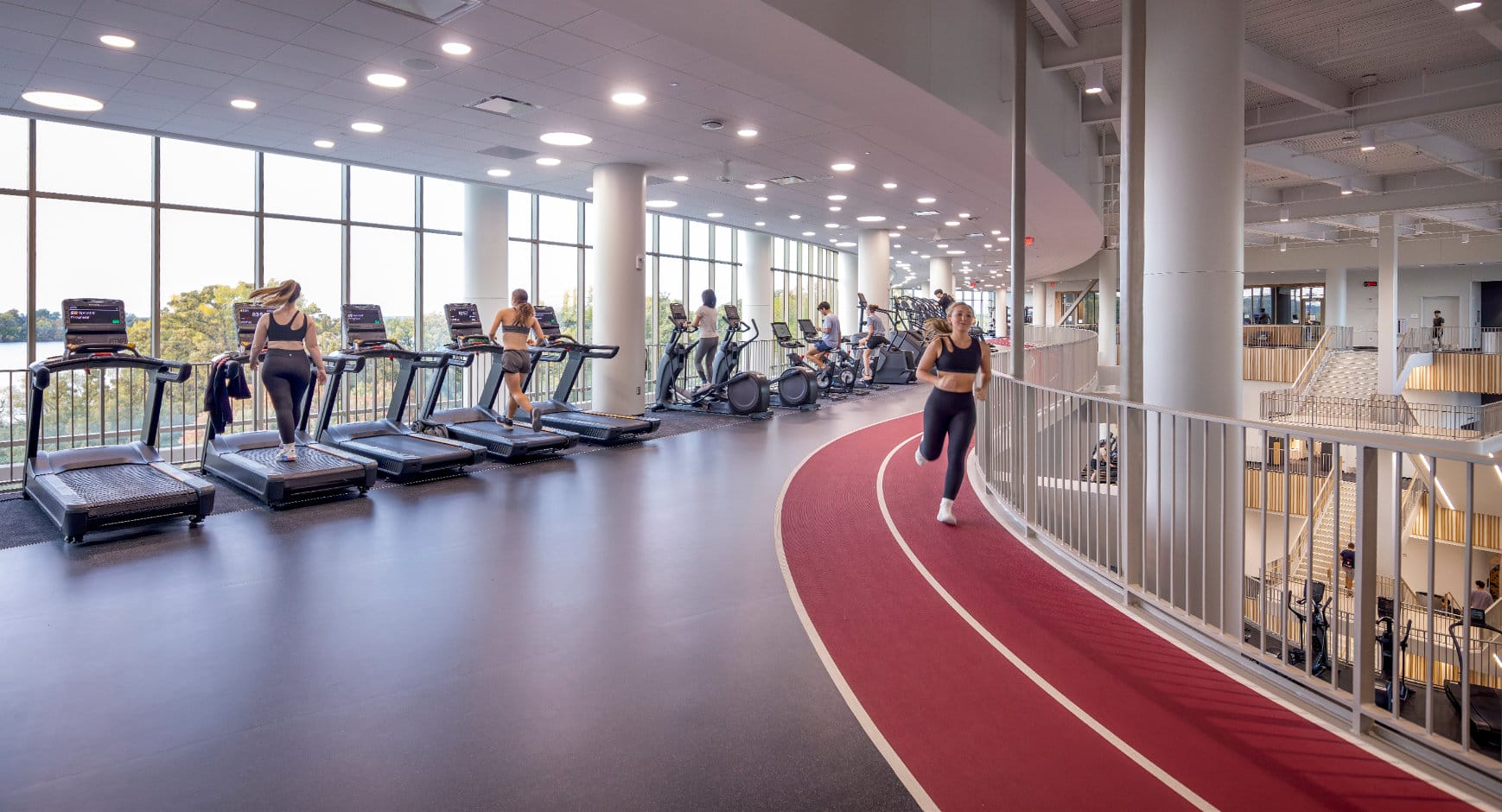
Smart Running Tracks
At the Paris 2024 Olympics, the track was among the most-watched architectural elements in the world. Yet track intelligence has lagged behind until recently.
That gap is closing fast. Advanced athletic tracks now embed sensor networks into the base structure, capturing foot strike patterns, force distribution, stride length and acceleration in real time.
Feldspar, an early mover in interactive track technology, has demonstrated how live velocity curves, contact times and fatigue profiles can be generated without timing gates or wearables. Their work signals not just a technological advance but a new commercial category: the track as an analytical asset.
Surface manufacturers are keeping pace. Polytan’s SMART systems layer wiring, anchors and cloud-connected instrumentation beneath synthetic surfaces, enabling coaches and venue operators to monitor deformation, stiffness and degradation across a season. Seiko’s instrumentation work is adding momentum, too, integrating precision timing and positional sensing directly into the surface ecosystem.
Visual pacing—intuitive lighting embedded in the track to help an athlete pace their effort—is emerging as one of the most promising developments. LED guidance lines are already being trialled to support precision pacing and safer night-time training. Translated to competition, they offer new possibilities for theatre and clarity, particularly in distance events where lap-level narrative can be difficult to convey. This technology could make the experience more immersive for athletes chasing records and more accessible for spectators following the action.
The integration of embedded timing and positioning systems is not far behind. Instead of relying on manually placed gates, smart tracks can auto-generate splits, heat maps and movement signatures with centimetre accuracy. The implications extend beyond athlete development. In a year when officiating decisions have drawn significant scrutiny, surface-level intelligence could offer greater transparency for judges and governing bodies.
For architects and operators, this marks a shift. The track is no longer just a surface to be specified. It is a platform requiring integrated power and data infrastructure, specialist contractor coordination and clear strategies for protection when the venue switches modes for concerts or other events.
Innovation Ahead: Adaptive Surfaces
Architects and surface designers hope that technology will eventually allow for a truly adaptive surface. The biomechanics of hurdling, sprinting and distance running differ so dramatically that a single stiffness profile can never be optimal for all. Wave technologies have already demonstrated how subtle variations in underlayer behaviour influence performance. The disparity in record progression between disciplines—with middle and long-distance events outpacing the sprints—highlights how sensitive different events are to material design.
Speculation about record cascades is seductive, but history offers caution. The Beijing Games are still remembered more for the shark suit’s distortion of swimming records than the athletes who set them. In Paris, many fans felt not enough records were falling, later learning that a 2.5-metre pool depth had suppressed top speeds. Athletics needs comparability across venues, but that is not a reason to avoid innovation. It is a reason to pursue it thoughtfully, redefining standards and boundaries as the science matures.
Within that framework, imagine LED pacing integrated as a native layer rather than an add-on. Imagine a surface that stiffens fractionally for sprint training and softens for high-volume aerobic work. Imagine broadcasts where wind modelling, surface temperature, mechanical response and athlete interaction produce real-time graphics that contextualise performance scientifically. These ideas are not far-fetched fantasies. The component technologies already exist in isolation. The next step is orchestrating them responsibly.
What’s Next
For track and field, the stakes are high. The next generation of running tracks will not simply be faster or softer—they will be smarter, more predictable and more attuned to athlete wellbeing. As football, rugby and other global sports lean deeper into surface engineering, architects and manufacturers have an opportunity to shape what these performance platforms should represent in a future where technology and tradition must coexist.
Sport has always pursued innovation. As surfaces become intelligent, the ground beneath the athlete will no longer be neutral. Properly regulated, it will be engaging, transparent and genuinely ground-breaking.