
Here are the brands featured this week:
ChatGPT
Click here to read the latest Access Innovation Newsletter

Here are the brands featured this week:
ChatGPT
Click here to read the latest Access Innovation Newsletter

The Ashes in Australia are a big deal and every England supporter I know was excited for the series.
The reaction to how it unfolded has been predictably emotional, with blame distributed generously across players, coaches, conditions, pitches, and planets. One thing, however, has been largely absent from the postmortem. Data.
England’s 2005 and 2009 Ashes wins were underpinned by rigorous data and analytical work. It went awol in Australia. A year ago, I had listened to someone in the coaching set up decry ‘the landgrab for sports tech’ and how ‘coaches be confident about their instincts and not rely on data’. It’s not an entirely unreasonable position but somewhere along the way, a baby was very clearly thrown out with the bathwater. Certainly, a couple of key data analysts moved on.
Narrative, bravado, instinct and belief are no substitute for evidence-led decision making. Bazball may well have restored confidence, aggression, and entertainment value, but while aggressive cricket may win sessions and headlines, it’s not a strategy for away victories.
If proof were needed, just look to how Europe won the last Ryder Cup. Whilst some attributed the win to the European players’ familiarity with the same ball brand, the truth is less romantic. There was a vast amount of data-led preparation … which built on the vast amount of data-led preparation in Rome. On both occasions it drove pairings, strategy, recovery, and psychology. And silverware.
Cricket has fewer variables and longer decision cycles than many elite sports, which should make analytics more, not less, valuable.
One lesson – among the many that were doubtless learned Down Under – is that great sport starts with great data. Add the bravado once the basics are in place.

Here are the brands featured this week:
Nike

When an event bills itself as the next frontier in sport, you’d hope the minimum requirement is that it sparks excitement or, failing that, curiosity. For me The Enhanced Games have managed neither, they’ve just left me very uneasy.
The inaugural event lands in Las Vegas this May and will openly permit performance enhancing drugs administered under medical supervision.
If World Records fall, the message is clear: enhancement works.
The athletes involved will be operating in tightly controlled conditions, with doctors, protocols and close monitoring. Young people watching at home who feel inspired to emulate winners will not. They will be going it alone with whatever looks vaguely helpful and probably with whatever is cheapest and easiest to find.
Supervised doping feels like playing fast and loose with athletes to manufacture spectacle. Surely sport is meant to be about excellence, not voyeurism. Once you cross that line, you are no longer testing honest human potential, you are staging something closer to The Hunger Games.
There is also a competitive absurdity here; do athletes signing up now automatically lose out because they are only just beginning their enhancement programs? Is there an arms race clock already ticking?
Then there is the question that should really unsettle governing bodies…if the Enhanced Games fail to deliver a cascade of shattered records, how effective is anti-doping currently?
British swimming, Ben Proud, reported rationale for taking part is that he is tired of chasing parity with athletes who doped and were never caught. It is a persuasive argument and one which may yet prove prophetic.
Will I turn off in disgust when May arrives? No. I want to see if the genie is in or out of the medicine bottle. If this event proves palatable the commercial implications are vast, not least of all with sponsorships from pharma, healthcare and technology brands. In turn, the broader sporting landscape could shift faster than anyone has properly considered.
Whether it proves to be a circus or a template remains to be seen, I know which I’d prefer.

Here are the brands featured this week:
Lenovo
Global Sport Group (GSG)
Click here to read the latest Access Innovation Newsletter

In marathon running, the myth is that it is all about the athlete. The truth is more interesting. The four great stages of this popular test of endurance – London, Berlin, Chicago and New York – each present participants with their specific challenge through surface, gradient and rhythm, and modern technology in footwear and apparel is increasingly designed to meet those specifics. Performance, in other words, is a negotiation between physiology and the environment.
Berlin remains the most-world record friendly because everything there is engineered for continuity. The course is flat, the camber is gentle, the asphalt is consistent, and the turns are forgiving. That stability is gold for today’s racing shoes, whose plates and foams deliver their best returns when ground interaction doesn’t change underfoot. Berlin hands athletes the luxury of running in a straight line, biomechanically and psychologically. For the marathon data-fixated, the sport’s fastest points cluster there.
Chicago is also rapid, but with more surface texture. Its presents just enough variety to demand micro-adjustments in loading, and the city’s grid exposes athletes to subtle shifts in wind and shade. Those in the know recommend to “go early” on the course, but what separates a good day from a great one is often comfort management; aerodynamic fabrics, the thermoregulation, and the ability to keep mechanically tidy when the asphalt refuses to be entirely uniform.
London sits somewhere in the middle. Its early miles are quick and clean while later ones are shaped by long straights and gentle rises that quietly tax the legs. The course is fast but not frictionless. This is where tech-led apparel earns real value: shoes that retain stability deep into fatigue, fabrics that reduce heat stress, uppers that hold the foot without over-correcting stride. London rewards those who can stay organized when form wants to unravel.
And then there is New York, the least predictable of the four. It’s bridges, inclines and harsher surfaces offer their own challenges, but the crunch is a layout that refuses to let athletes fall into rhythm. It tests resilience more than pace. Technology still helps, but the emphasis shifts from bounce to control: footwear that keeps athletes centred, fabrics that adapt to changing microclimates, and apparel systems that prevent athletes from haemorrhaging energy long before Central Park.
What the Big Four demonstrate is that endurance running has entered a genuinely technical era. Surfaces, gradients and materials shape outcomes just as much as tactics. If the course is the song, but increasingly the tools athletes bring with them…shoes, fabrics, and data…determine how it’s sung.
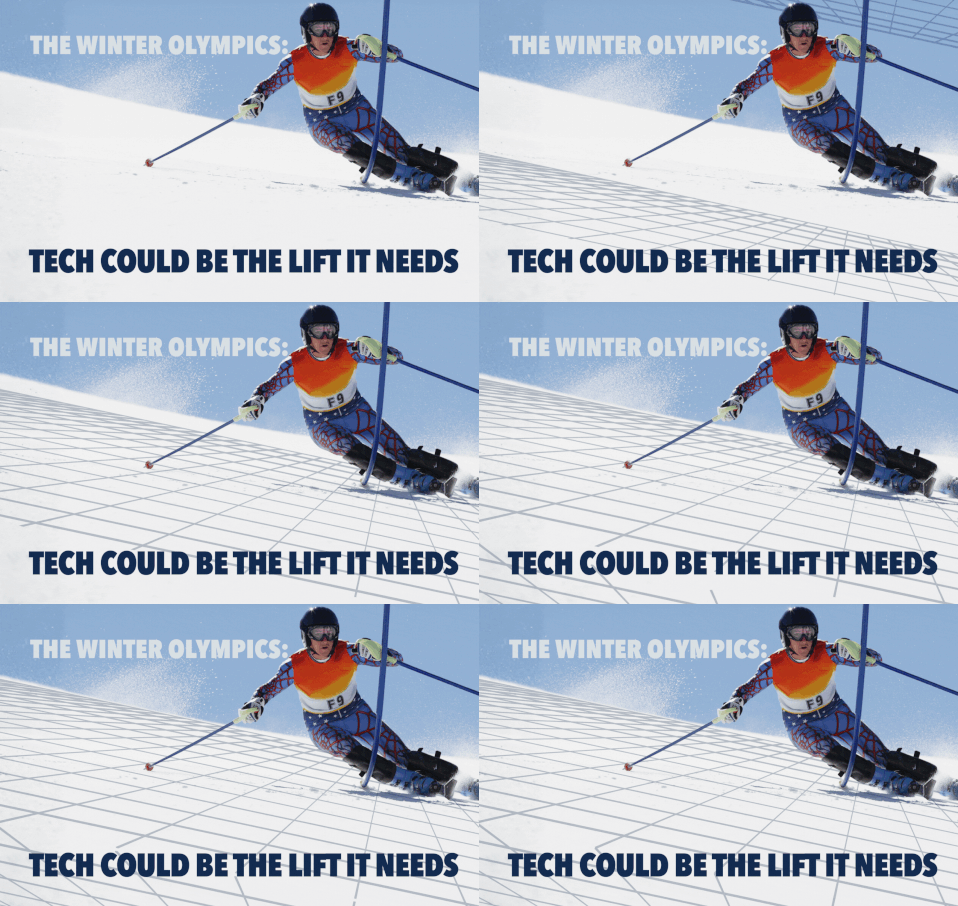
The next Winter Games is only weeks away, and word has it there is a touch of anxiety at IOC HQ. Not panic, just the quiet realization that the world has changed faster than The Games have kept pace. Somewhere in the building, a Fit for the Future strategy paper is doing the rounds. It looks at how the Winter Games might appeal to new audiences, lift visibility and steady the model for the decades ahead.
Good. It is needed. Anyone remembering organizers trying to make snow quicker than the sun can melt it will agree the sustainability question cannot be kicked any further down the piste. Sochi’s vanishing white carpets and Nagano’s gently rusting infrastructure are reminders that even the most storied sporting festivals need a post-competition plan.
But the other parts of the strategy – the bits about visibility and ‘reaching new audiences’, including mooting making judo a winter sport – that is simpler to solve. Winter sport has a habit of forgetting one essential rule of modern attention: stars and their stats sell. Stars create anticipation, turn events into occasions and pull in casual fans. Yet the Games behave as though their job is to mint champions, not to build the stage long before the opening ceremony.
It is the opposite of what every successful sport does. In football, tennis, golf, Formula One – even darts – the marketing engine never sleeps. Using the very best social media and marketing tech available, it creates household names months in advance and invites audiences to follow the characters as much as the competition. By comparison, the Winter Games still operates on a sort of ‘if we build it they will come’ philosophy.
Except they do not always come. Ask the average person to name an athlete expected to compete in February. If you hear ’Mikaela Shiffrin’ or ‘Chloe Kim’, you have found a connoisseur. Despite millions skiing every year, that vast pool of participation does not convert into viewers at Games time.
And that is the puzzle worth solving. Winter sport has the drama, the jeopardy, the gravity defying brilliance – and a pretty backdrop – to captivate almost anyone. What it has not done is shine a bright enough light on the athletes early enough. Make more stars before the Games and you turn the event from a two week showcase into a season long story.
Do that, and the slide stops. Judo stays put in the summer, and the Games rediscover the momentum they deserve.